Skip to content
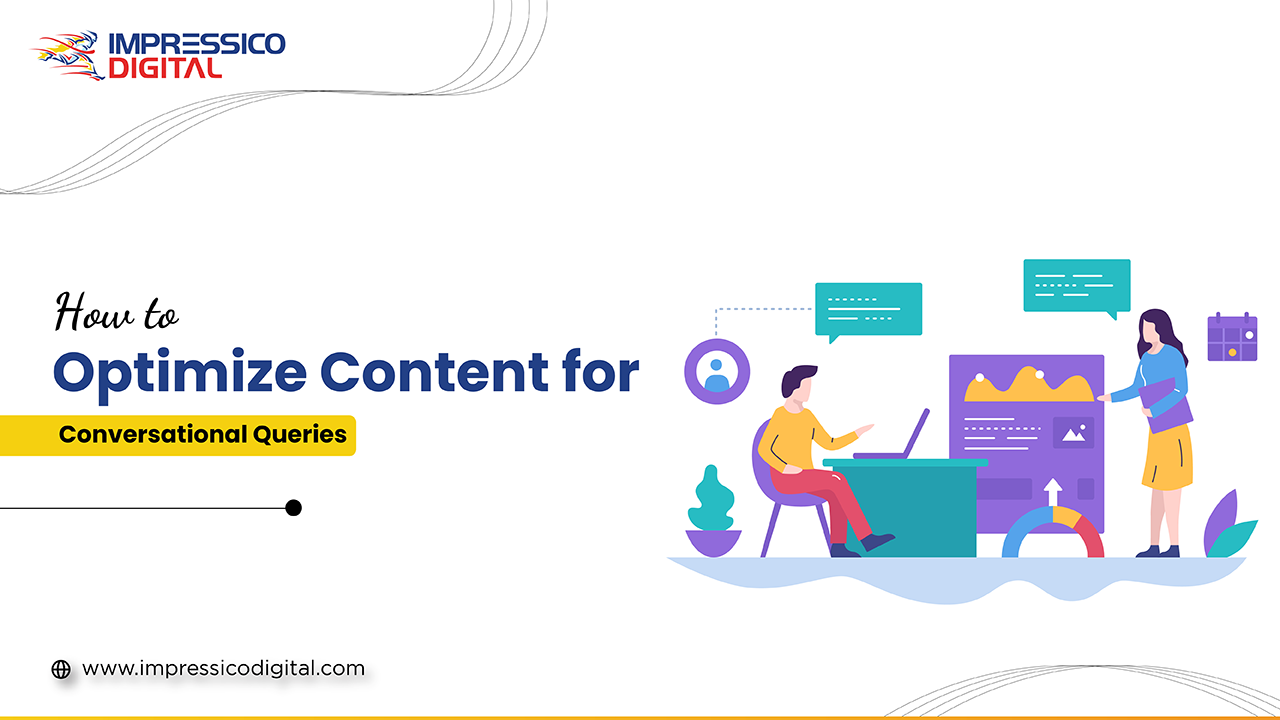
The way people search has changed-and fast. They’re no longer typing stiff, robotic keywords into Google. Instead, they’re talking to search engines the same way they talk to people. Questions like “How can I rank for voice search?” or “What’s the best way to optimize content for AI search?” are now the norm.
That’s where conversational search comes in.
At Impressico Digital, we see brands struggle because their content is still written for old-school SEO. If your pages don’t sound natural, answer real questions, or align with AI-driven search results, you’re already falling behind. This guide breaks down how to optimize content for conversational queries-the right way.
What are conversational queries?
Conversational searches are searches phrased in their natural, human language. No more typing “SEO tips,” but instead users ask questions like, “What SEO strategies actually work for small businesses?”
These are led by the following questions:
- Natural language search
- Voice Assistants like Google Assistant, Siri
- Long question-based phrases
- Real user intent, rather than exact-match keywords
As voice assistants make headway and AI-powered results become common, conversational queries are setting the way in which content is discovered, its ranking, and even AI-generated overviews.
Why Traditional SEO Isn’t Enough Anymore
Traditional SEO was heavily based on placement keywords, backlinks, and exact-match phrases. However, the game of traditional SEO vs. conversational SEO is totally different today.
Search engines now give preference to:
- User’s intent to repeat a keyword
- Context instead of isolated phrases
- Clear answers rather than long-winded and vague explanations.
AI-powered search results and answer engine optimization (AEO) require clear content that directly answers what users are asking. If your content isn’t clearly answering questions, it’s not going to surface for AI Overviews, no matter how technically optimized it may appear on paper.
How Search Engines Handle Conversational Queries
Modern search engines use conversational search optimization, which is driven by AI. They consider:
- Semantic meaning
- Context across multiple words
- Previous search behavior
- Conversational patterns
Search engines today know “why” a user is asking something, not just “what” they typed, through semantic search, generative engines – GEO, AI perspectives.
That’s why content written naturally, with a structure and in a human tone, gets better results in AI-powered results.
Targeting Long-Tail & Question Keywords
We focus on longtail conversational keywords to win at conversational search. These include longer, but more particular phrases that reflect the way people talk.
Examples are as follows.
- How can I optimize my website for voice search?
- What is the best format for AI search results?
- Why is conversational SEO important?
It helps match the intent of your content perfectly, making it very simple for AI systems to extract and give attribution to your answers via question-based phrases and real user questions.
Use FAQ Sections to Match Search Intent
One of the most effective strategies for integrating FAQs with conversational keywords directly into your content.
FAQs help to
- Match numerous user intents on one page
- Trigger featured snippets
- AI Overview questions should be directly answered
Well-structured FAQs act like ready-made answers for search engines. If written clearly, they increase your chances of a citation by AI-driven results manyfold.
Formatting content for AI readability
AI doesn’t “read” the content the way humans do; it’s all about scanning for clarity, structure, and relevance. And this is exactly where schema markup comes in with regard to conversational SEO.
Best practices include:
- Clear H2 and H3 Headings
- Small paragraphs
- Bullet points and lists
- Direct answers towards the top of sections
Making sure that your page uses FAQ schema and featured snippet optimization makes it easier for AI systems to pull accurate responses from your page.
Writing Tone & Natural Language Matters
If your content sounds robotic, it won’t work. Period.
The natural language content, which mimics exactly how people could have a normal conversation. That means:
- Simple sentences
- Explanation in detail
- A friendly, human tone
- Voice query style phrasing
Mainly, the engines continue to reward conversational tone and direct answers, especially through voice and AI-generated results.
Using Structured Data to Enhance Visibility
Implementing FAQ schema markup and HowTo schema helps the search engines understand your content.
Advantages of Structured data are:
- Improved AI understanding.
- Better eligibility for rich results
- Stronger voice assistant compatibility
When structured data underpins well-written content, it greatly improves the possibility of ranking and being cited.
Measuring & Improving Conversational Search Performance
Optimization doesn’t stop after publishing.
Track conversational search metrics such as:
- AI Overview visibility
- Voice Search Impression
- Question-based keyword rankings
With our AI Overview tracking and voice search analytics, we tune content all the time to make it more clear, relevant, and performing.
FAQs
What are conversational queries in SEO?
The conversational queries are natural and question-oriented searches, reflecting how people speak rather than type.
How does conversational search differ from traditional search?
Conversational search is all about intent, context, and direct answers instead of exact-match keywords.
Why is optimizing for conversational queries important?
Conversational content helps AI-powered results, voice search, and Google AI Overviews to present accurate answers.
How can I identify conversational keywords for my content?
Use user intent questions, long tail, voice search, and conversational queries that Google offers, such as “People Also Ask.”
What role do FAQ sections play in conversational SEO?
FAQs help with the mapping of multiple intent, improve eligibility for featured snippets, and increase the chances of AI citations.
Can structured data improve performance for conversational queries?
Yes. Structured data helps the AI and voice assistant more easily understand and surface your content.
Final Thoughts
By optimizing content for conversational queries, we must stop writing for algorithms and start writing for real queries: understand the real questions, real frustrations, and real expectations; deliver answers clearly.
At Impressico Digital, we help brands adapt their SEO strategies for AI search, voice assistants, and conversational discovery. If your content isn’t showing up in AI Overviews, it’s time for a change.
Ready to future-proof your SEO strategy?
Let’s optimize your content for how people actually search today-and how AI ranks tomorrow.
Connect with Impressico Digital and start ranking where it matters most.
Want to know more about us? Follow us on social media!