Skip to content
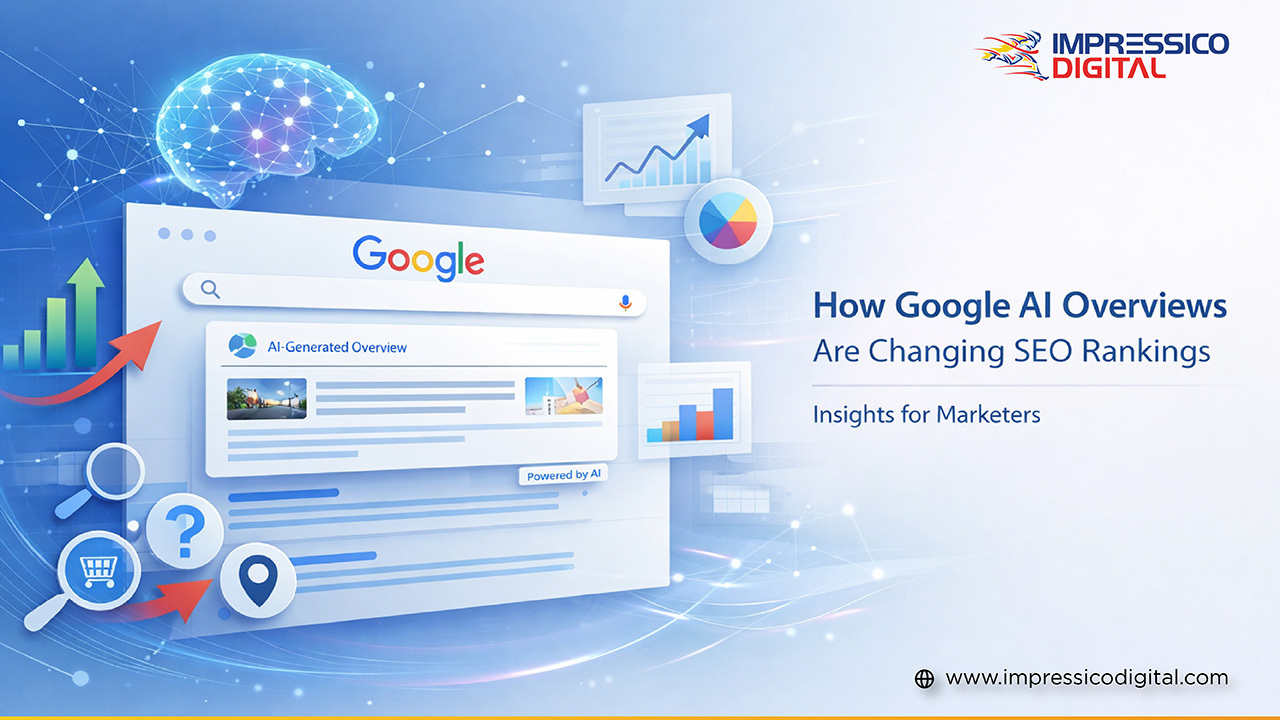
Google’s AI Overviews (the brief, generative responses that usually appear as the top search result) are redefining what it means to be “visible”. Searchers are being provided synthesized answers more often without even having to leave Google, so the old measure — ranking position alone — no longer tells the whole story. Smart marketers are now seeing AI Overviews as potential new channel opportunities, as well as threats to the click-to-website metrics at the same time. AI Overviews can promote your content to searchers as a highlighted response to their search query, but they can also organically replace clicks, unless the content is extremely well optimized in order to capture the click or convert in other ways.
What are Google AI Overviews?
Google-generated response summaries that aggregate content from several sources across the web to provide a concise answer with links through citation cards on the side. The AI overview type of response is usually featured above organic results for informational queries and can include bullet-pointed lists, steps, or just very short answer methods in order to provide the user with a quick and actionable result listed on the SERP. If you want to know more about Google AI Overview read this blog.
How AI Overviews Change the Search Landscape (short version)
There are two crucial shifts that impact SEO: the first is frequency; AI Overviews are appearing on a large number of queries. The second is impact: where they appear, they often lower clicks to organic results (the “zero-click” effect). Recent analysis of the industry shows that AI Overviews appear on a proportionately high share of queries, and observational studies show that they sharply decrease organic click-through rates when AI Overviews do appear.
What queries are most affected?
AI Overviews appear mostly on longer questions and informational queries (how/why/what), and much less frequently on time-sensitive or local queries. There are also some types of high-visibility verticals (medial/YMYL) and comparison queries, which are frequent, so these areas also require additional attention.
Important nuance: AI Overviews ≠ ranking penalty
Google has stated that AI Overviews are just an additional presentation layer and do not directly affect which pages are ranked as first in the core algorithm. They change SERP behavior and change how frequently users click on the blue links to get more information. Google guidance also warns that if these pages are spamming the web with mass production of low-value content, then Google would classify these results as spam, which cautions those creating content in these areas for quality vs quantity. (Google for Developers)
Clear, Practical Answers to Today’s Biggest SEO Questions
Let’s identify the burning questions that are top of mind for people right now- and provide clear answers you can actually utilize for your SEO planning.
Q: How should I structure content so my page still gets traffic?
Write a brief lead between 40-80 words that directly answers the question, then follow that up with a unique section of authority (data, viewpoint, use of original examples). The content will help surface your answer with the AI overview or PAA; the deeper section then gives users a reason to click, and a reason to engage when they come. Use a clear H2/H3 hierarchy for the headings so that Google can find the exact snippet to cite it. Follow the E-E-A-T concept.
Q: Can schema/structured data help?
Yes. Use FAQ schema, HowTo schema, and Article schema when available- it makes it easier for Google to understand the structure of the answer, and can feed into other SERP features. Schemas don’t equal clicks- they don’t substitute for a good lead and original value.
Q: Should we use generative AI to create content?
Generative tools can be useful for drafting and research, but Google has said that mass-generated pages that do not add anything can’t simply lose perspective. If you use AI, layer in original reporting, expert quotes, or proprietary data to ensure value and avoid scaled-content issues.
Q: How do we earn clicks when AI Overviews appear?
Two strategies are as follows (1) Make the first answer captivating – include a brief statement that suggests tailored expertise on the topic (“Here’s what our client study in 2025 indicates…”) so that the user wants to “read more” (2) Diversify- push people to newsletters, socials, and direct channels so you’re not only relying on organic clicks.
Q: How should we measure success now?
Keep track of impressions and clicks specific to the AI feature in Search Console, track overall organic traffic and changes to CTR, and layer conversion metrics (leads, signups) vs raw sessions for context. Look for shifts in behavior, i.e., you may have impressions but clicks are down.
Three immediate tactical moves
- Content triage. Identify your top 200 informational pages (by impression) and tag on the front end a one-paragraph lead that answers the query + one unique data point or case.
- Schema sweep. Add FAQ and HowTo schema to pages answering explicit user questions.
- Traffic diversification. Initiate or step up a minimal weekly newsletter CTA on key pages to reach users who won’t click through from search.
If you want support to expedite the execution of this work, our team at Impressico Digital can conduct the content triage, implement schema, and set tracking in Search Console to see the impressions specific to the AI feature clearly.
Risks & pitfalls to avoid
- Using AI outputs with no editorial contribution – Google flags scaled, low-value generative content.
- Treating AI overviews as irrelevant – AI overviews shift user behavior and could negatively impact click volume if ignored.
- Not tracking for feature impressions – Search Console has special reporting and quirks to track AI feature impressions; if you’re not monitoring, you’ll miss the signal.
Measurement Checklist
- AI feature impressions & clicks (Search Console)
- Change in query-level CTR before vs. after adding AI overview.
- Page Engagement (time on page, scroll depth) for pages that continue to get clicks
- Newsletter signups and direct traffic lift from interstitial CTAs
- Conversion rate per channel (organic vs. email vs. social)
Long game: Why original reporting and brand are more important than ever
When Google synthesizes answers, it’s still reliant on source signals: trust, authority, and unique evidence. Brands that produce original research, expert interviews, or proprietary tools have a better chance of being cited (and converting that smaller audience that clicked). Building strong editorial voices, data, and trusted brand touchpoints is the best hedge against declining organic clicks.
Conclusion
Google’s AI Overviews will not render SEO obsolete – merely change the definition of “winning.” Instead of viewing the overview as the “end” of anything, consider it a new SERP placement to be worked for and measured. With that said, we’ll be happy to audit your website and report back:
(a) A prioritized list to update,
(b) Suggested lead paragraphs for each page, and
(c) Schema snippets
Ready to stop losing clicks — and start capturing the ones that matter? Book an AI-search audit with us today.
Want to know more about us? Follow us on social media!