Every marketing campaign has one major objective: convert visitors to paying customers. But here’s the reality that doesn’t get talked about enough: traffic doesn’t pay the bills. What drives growth is how efficiently you move people through your conversion funnel – from “I’m just curious” to “I’m ready to buy.”
If you have been spending money on ads, SEO, or social campaigns and your sales aren’t increasing, it is likely that visibility isn’t the issue. The culprit is conversion flow. When you do conversion funnel optimization, you analyze each step of where users exit, refine the funnel, and ensure that every step is effortless.
When a conversion funnel is optimized, the sales don’t just increase but it reduces cost per acquisition, generates greater ROI, and creates consistent momentum to your business model through the good and difficult times.
What is a conversion funnel?
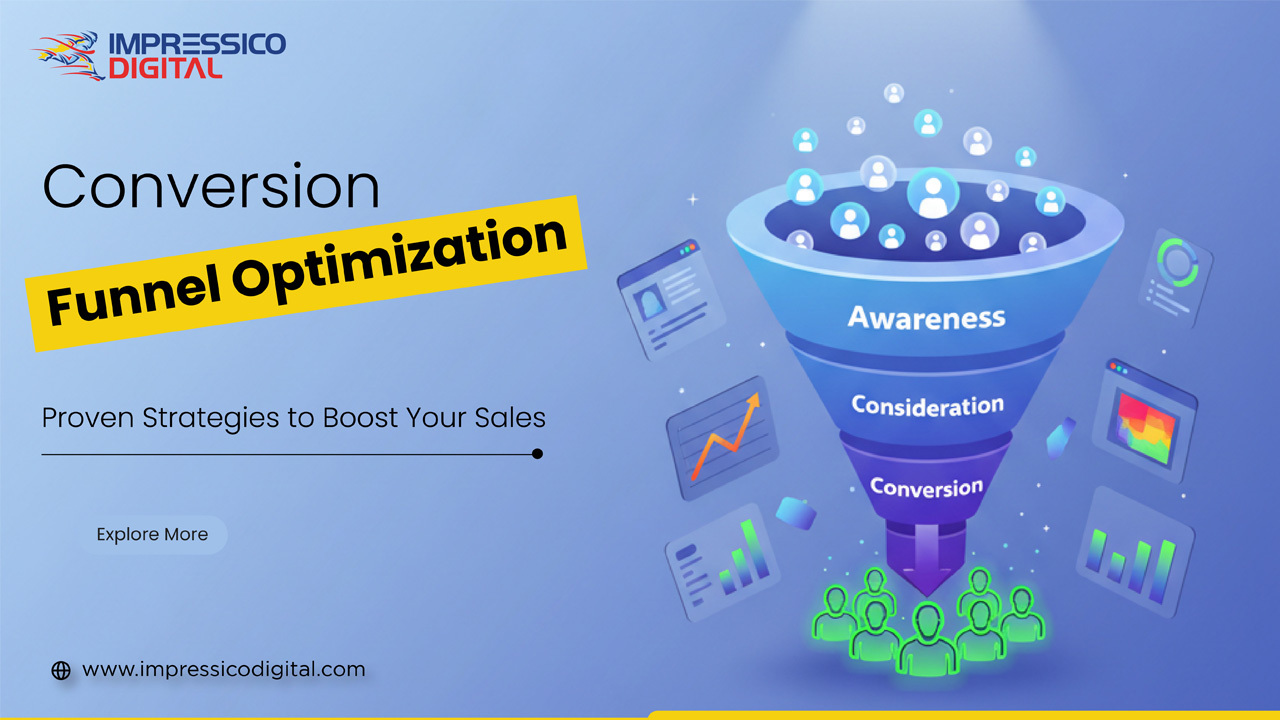
A conversion funnel (or sales funnel, or marketing funnel) is a visual pathway of a prospect from exposure of your brand to an action (a sale, a subscription, a registration, etc.). According to Search Engine Journal: “Conversion funnels … help potential buyers move through distinct steps before they take the desired action.”
Let’s break down those steps.
- Awareness – The visitor becomes aware of your product or service through ads, search, or word-of-mouth.
- Interest – They check out, read, or follow your brand.
- Consideration – They start to compare, check reviews and think about what to do next.
- Action – They make the last step: purchase, book, or sign-up.
- Retention – The point at which you turn a one-time buyer into a loyal advocate.
Each click, scroll, and hesitation is telling a story about what’s working — and what’s leaking.
Why Most Funnels Leak — And What the Numbers Tell Us
Here is a sobering truth: even the best marketing funnels leak more than you think.
Research found that the average funnel conversion rate (across industries) is just under 2.35%, while the top 10% of performers are at 5%+. That is to say, for every 100 people who find you, 2 or 3 convert.
A study found: brands lose around 38% of users between stages one and two of the funnel, and another 29% moving between stages two and three. The further you go down the funnel, the smaller the crowd that remains.
So what’s going on here?
- Intent mismatch: Individuals may generate a certain promise through your ad, but land on a page with another story.
- Clunky design: Slow load times or too few, or too many details to fill out in the form keep folks from converting.
- Weak value proposition: If they can’t clarify why your offer matters, then they’ll immediately go back.
- Lack of trust: No testimonials, unclear pricing, or salesy language makes them nervous.
Conversion funnel optimization simply involves finding those weak links and moving hesitancy into action.
5 Proven Strategies to Optimize Your Conversion Funnel
Now, we can go through specifically what works.
Strategy #1: Map and Measure Where People Drop Off
Before you can even begin optimizing your conversion, you should know exactly where it falls apart.
According to Search Engine Land, “You need to identify where prospects are disappearing and what is holding back your conversions.”
So to start out, you should define your busy funnel in clear stages:
- Landing Page/Page views
- Clicks on product pages or CTAs
- Cart adds or forms submissions.
- Checkout Funnel or Purchases
Now, calculate your conversion rate on each stage instead of relying on total conversions. For example, if you have 5,000 people land on your site but only 100 make it to checkout, then your stage-three conversion rate is 2%.
Once you know which stage loses the most users, prioritize fixing that one first. This data-driven focus helps you avoid guessing and spend time where it truly matters.
Strategy 2: Match Your Content to the Right Intent
Content is not just about keywords for search engine optimization but about being in line with intent.
Those at the top of your funnel (in the awareness stage of the funnel) want to learn. Those in the middle of your funnel want to compare, and those at the bottom of your funnel want to buy.
According to Search Engine Land, aligning keywords and content with where the user is in the funnel will provide an experience where every visitor is seeing the content they are actually ready for.
This looks like the following:
- Top of the funnel (ToFu) content – informative, problem-aware, educational.
- Middle of the funnel (MoFu) content – comparisons, case-studies, testimonials.
- Bottom of the funnel (BoFu) content – offer, pricing, CTA, urgency.
Additionally, this makes the user navigate through your funnel logically instead of bailing out because they were served the wrong message based on the funnel stage.
Strategy #3: Treat Landing Pages like Sales Conversations
If your landing page does not show value quickly, you freeze your funnel.
- The goal is to optimize for no friction on the landing pages.
- Don’t include links to other pages. Navigation links can be distracting.
- Use easy-to-read headlines to say what’s in it for me (or them).
- Keep forms short, usually name and email and sometimes one other qualifier.
- Add real testimonials or badges of trust like security seals or logos.
Sometimes it is just little things that make large differences, but even changing the CTA from “Submit” to “Get My Free Demo” can lift conversions a noticeable amount.
Brands that consistently test and optimize landing pages see measurable conversion rate lifts.
Strategy 4: Use Segmentation, Personalization, and Social Proof
No two visitors act in the same manner. So why display the same message?
Segmentation allows you to create a funnel based on the source, device, or intent. Personalization enhances relevance, such as offering returning visitors a special offer or showing similar products to those they viewed previously.
Social proof is the final credibility litmus test. When users are able to see the reviews, a user count, or a case study, they are much more comfortable taking a leap of faith.
At Impressico Digital, we use technology to track visitor behavior and leverage dynamic content to provide a more personalized experience. The work takes more than just technology – it takes empathy. Thinking through the motivation of your audience makes it much easier to create a pathway toward conversion.
Strategy 5: Test, Learn, Adapt.
Funnel optimization is not something you “set and forget.” You need to test A/B variants, monitor how changes affect each stage, and iterate. Optimization is all about understanding your audience, testing the information and measuring the results while adjusting in accordance.
Example strategies:
- A/B test copy for your CTA, button color or placement.
- Test different offers (i.e., free trial vs. demo vs. discount).
- Continue tracking the amount of time for contacts to convert, and where they drop off from the funnel from stage to stage.
- Once one stage improves by applying variations, then move on to the next bottleneck.
Even minor lifts compound over time. Increasing your conversion rate from 2% to 3% might not sound dramatic, but that’s a 50% increase in revenue without extra ad spend.
How We Can Help You
We know that most marketing teams already juggle content, ads, and analytics — and conversion funnel optimization can feel like another complex layer. That’s why we simplify it.
At Impressico Digital, we initiate a full-funnel audit process. We uncover friction points, implement user-journey tracking, and create congruence between your messaging and intent. Then we optimize your funnel step-by-step – we optimize pages, test creative variations, and automate follow-up emails to convert cold leads into warmer prospects.
Whether a brand is on an eCommerce site, or a SaaS company, or a B2B service provider, we create a funnel that optimizes converting a visitor once, but to convert a visitor again.
FAQs
1. What does conversion funnel optimization mean?
It means analyzing every step of your customer journey and improving it to reduce friction, create engagement, and increase the percentage of individuals who actually perform your desired action.
2. How long will I see results?
Typically, you will see small but noticeable improvements in performance in the span of 4 – 8 weeks. For meaningful transformation, it generally takes at least three months of continuous testing, iterating, and refining for experts.
3. Which tools measure performance in the funnel?
Google Analytics, Hotjar, Mixpanel, and HubSpot are common among these tools. It is not the tool that matters, but rather the takeaways and insights you are able to leverage from it.
4. Can funnel optimization be a good alternative to paid advertising?
Absolutely not, however, it will make your paid spend much more efficient. With funnel optimization, you will convert more customers using the same amount of paid advertising budget.
5. What’s the biggest mistake businesses make?
They assume once a funnel “works,” it’s done. But audience behavior, algorithms, and competition change constantly. Continuous improvement is the only sustainable way to stay profitable.
Final Thoughts
Your conversion funnel is the heartbeat of your online business. You can have stunning ads, great SEO, and a powerful product — but if your funnel leaks, growth stalls.
By mapping your funnel carefully, matching content to intent, optimizing landing pages, personalizing communication, and testing relentlessly, you create a system that keeps improving itself.
If you’re serious about turning visitors into loyal customers, it’s time to act.
Let’s optimize your funnel and boost your conversions — together. Contact Impressico Digital today to get started.
Want to know more about us? Follow us on social media!