Skip to content
The search process has transformed more over the past two years than it has over the previous decade. Users are no longer typing all queries on Google and reading through the first ten blue links. Today, millions of people type their queries to AI assistants such as ChatGPT, Gemini, Claude, and Perplexity, expecting timely, factual, and conversational responses.
And this trend is opening up a whole new set of opportunities for brands.
In case your site ranks in conventional searches but has never been quoted by any AI tool within the context of an answer to some other user, you might already be losing out on qualified traffic, authority, and visibility.
This is when ChatGPT SEO, ChatGPT search optimization, and Generative Engine Optimization (GEO) come into play.
In the report by Adobe, 77% of ChatGPT users report using the platform as a search engine. Nearly one-quarter of these respondents now begin their search journeys at ChatGPT and avoid traditional search engines altogether.
That figure alone gives us a hint as to why companies that figure out ChatGPT optimization today will find themselves with a competitive edge in the future.
In this article, we’ll walk you through ChatGPT source selection, content citation, and what your business can do right now to improve AI visibility.
What Is ChatGPT SEO and How Can You Rank in ChatGPT?
ChatGPT SEO refers to the optimization of your website for understanding by AI-powered search engines such as ChatGPT from OpenAI, Google AI Overviews, Perplexity AI, and others, which generate information that is then used as part of their answers.
To rank in ChatGPT, businesses need structured content, strong entity signals, schema markup, expert-backed insights, authoritative mentions, and content that directly answers user intent.
This matters more than ever. According to Gartner, traditional search engine volume is expected to decline by 25% by 2026 as users increasingly shift toward AI chatbots and virtual agents.
- Traditional SEO focuses on rankings.
- ChatGPT SEO focuses on citations.
Traditional search asks:
“Can this page rank?”
AI search asks:
“Can this source be trusted enough to answer?”
That difference changes everything.
When someone asks ChatGPT:
“Who offers the best enterprise software development services?”
or
“What are the best digital marketing strategies for SaaS brands?”
ChatGPT may reference websites, studies, articles, or expert sources to generate its answer.
The goal of ChatGPT search optimization is simple:
Make your content one of those sources.
Why ChatGPT SEO Matters More Than Ever
AI adoption is accelerating faster than most businesses expected.
OpenAI’s own research shows ChatGPT usage has expanded far beyond early adopters, with information-seeking and practical guidance becoming two of its largest use cases.
At the same time, enterprise AI adoption continues to grow. OpenAI reports more than 7 million workplace seats across enterprise customers, while enterprise usage increased nearly 9x year over year.
Adobe’s 2025 research also found:
- 36% of users discovered a new product or brand through ChatGPT
- 47% of marketers already use ChatGPT for promotion
- Two-thirds plan to invest more in AI visibility in 2025
This tells us one thing clearly:
AI is no longer an experiment.
It is now a discovery engine.
And if people discover products, services, and brands through AI answers, then learning how to rank in ChatGPT becomes a business priority.
ChatGPT Search in 2026: Quick Facts
Here are some numbers that show how quickly AI search is changing user behavior:
- OpenAI ChatGPT now serves hundreds of millions of users globally every week.
- According to multiple industry studies, AI-generated search experiences now appear across a growing share of informational queries.
- A large-scale 2026 academic study across 243 countries found AI search exposure expanded rapidly between 2024 and 2025, with generative answers becoming the default experience for many informational queries.
These numbers confirm what many businesses are already seeing.
ChatGPT SEO vs Traditional SEO vs GEO
Many brands still treat AI visibility like traditional search visibility. That is a mistake.
Traditional SEO helps pages rank in search results.
Generative Engine Optimization, or GEO, helps brands get cited inside AI-generated answers.
If you want a deeper understanding of GEO, you can also explore our guide on Generative Engine Optimization (GEO): Ensuring Your Brand Gets Cited by AI.
Both strategies matter, but they work differently.
| Traditional SEO | ChatGPT SEO | GEO |
| Focuses on rankings | Focuses on citations | Focuses on AI visibility |
| Click-driven | Answer-driven | Mention-driven |
| SERP optimization | Retrieval optimization | Cross-engine optimization |
| Position-based | Trust-based | Authority-based |
Academic research on Generative Engine Optimization shows AI systems often prioritize earned media, authoritative sources, and machine-readable content over pure brand-owned content.
That means brand authority matters more than ever.
How ChatGPT Chooses Which Websites to Cite
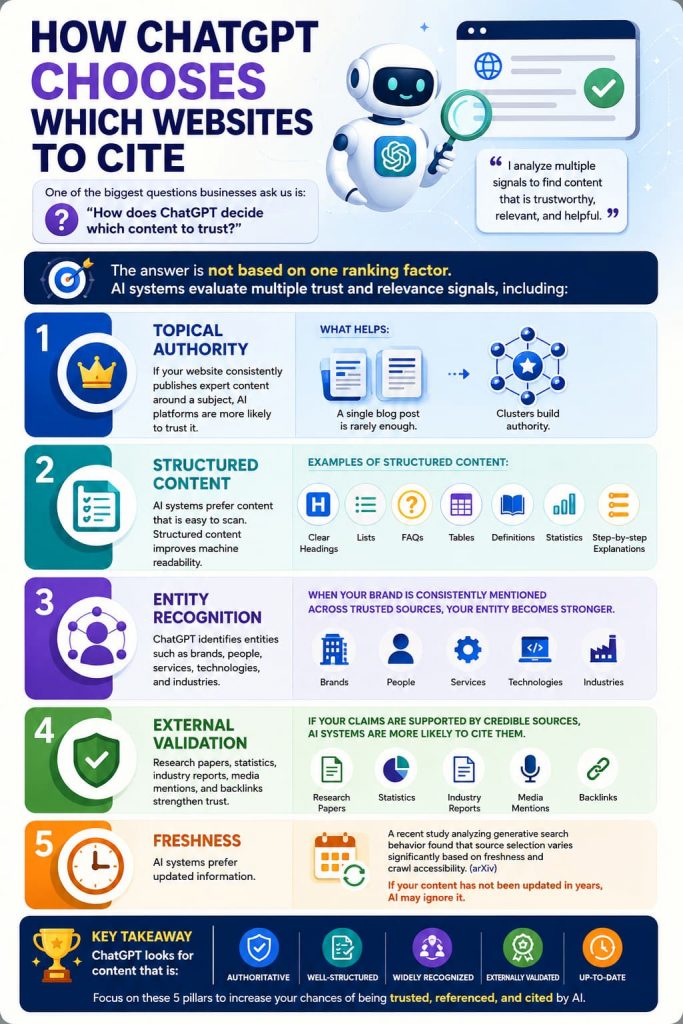
One of the biggest questions businesses ask us is:
“How does ChatGPT decide which content to trust?”
The answer is not based on one ranking factor.
AI systems evaluate multiple trust and relevance signals, including:
1. Topical Authority
If your website consistently publishes expert content around a subject, AI platforms are more likely to trust it.
A single blog post is rarely enough.
Clusters build authority.
2. Structured Content
AI systems prefer content that is easy to scan.
That includes:
- Clear headings
- Lists
- FAQs
- Tables
- Definitions
- Statistics
- Step-by-step explanations
Structured content improves machine readability.
3. Entity Recognition
ChatGPT identifies entities such as brands, people, services, technologies, and industries.
When your brand is consistently mentioned across trusted sources, your entity becomes stronger.
4. External Validation
Research papers, statistics, industry reports, media mentions, and backlinks strengthen trust.
If your claims are supported by credible sources, AI systems are more likely to cite them.
5. Freshness
AI systems prefer updated information.
A recent study analyzing generative search behavior found that source selection varies significantly based on freshness and crawl accessibility.
If your content has not been updated in years, AI may ignore it.
People Also Ask: How ChatGPT Rankings Actually Work
Does ChatGPT use Google rankings?
Not directly. While strong traditional SEO can improve your visibility, ChatGPT does not simply copy Google rankings. A recent academic study found that traditional search engines and AI-generated search results often retrieve entirely different sources for the same query.
That means a page ranking on Google may still not appear inside AI-generated answers.
Can a new website rank in ChatGPT?
Yes. If your content is well-structured, supported by credible sources, and clearly demonstrates expertise, smaller websites can compete with larger brands in AI search.
In many cases, content quality and machine readability matter more than domain size.
How often do AI search results change?
AI search visibility can change frequently as models refresh data, discover new sources, and reevaluate authority signals.
That is why content freshness, updates, and ongoing entity building matter.
The CITE Framework We Use for ChatGPT SEO
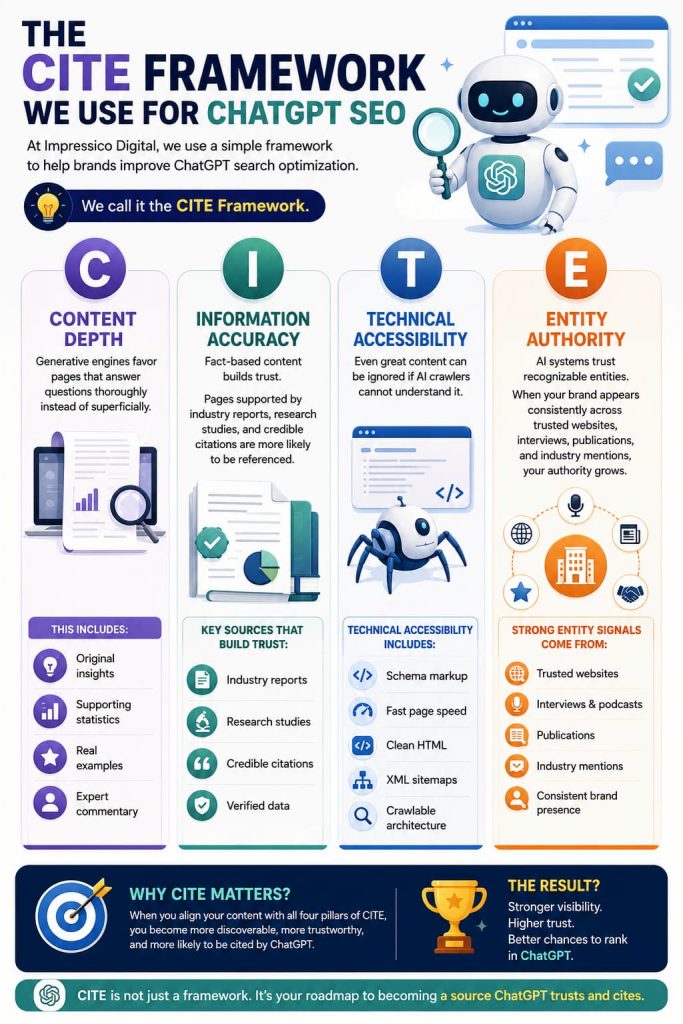
At Impressico Digital, we use a simple framework to help brands improve ChatGPT search optimization.
We call it the CITE Framework.
C — Content Depth
Generative engines favor pages that answer questions thoroughly instead of superficially.
This includes:
- Original insights
- Supporting statistics
- Real examples
- Expert commentary
I — Information Accuracy
Fact-based content builds trust.
Pages supported by industry reports, research studies, and credible citations are more likely to be referenced.
T — Technical Accessibility
Even great content can be ignored if AI crawlers cannot understand it.
Technical accessibility includes:
- Schema markup
- Fast page speed
- Clean HTML
- XML sitemaps
- Crawlable architecture
E — Entity Authority
AI systems trust recognizable entities.
When your brand appears consistently across trusted websites, interviews, publications, and industry mentions, your authority grows.
That improves your chances to rank in ChatGPT.
10 Proven Strategies to Rank in ChatGPT
Now let’s focus on practical execution.
Here are the strategies we use to improve ChatGPT SEO and ChatGPT search optimization for modern brands.
1. Build Topic Clusters Instead of Isolated Blogs
Answer engine trust expertise, not random articles.
Instead of publishing one post about AI SEO, build supporting content around:
- GEO
- AI search optimization
- Entity SEO
- Schema markup
- AI Overview optimization
- LLM visibility
This builds topical authority.
2. Answer Questions Immediately
AI systems love answer-first content.
Instead of lengthy introductions, answer the core question in the first 40–60 words.
That improves your chances of being retrieved.
3. Add Real Statistics
Numbers build trust.
For example:
Semrush’s 2026 clickstream analysis found outbound referral traffic from ChatGPT grew 206% in 2025.
Data like this improves citation potential.
4. Use Schema Markup
Schema helps machines understand your content.
Important schema types include:
- FAQ schema
- Organization schema
- Article schema
- Author schema
- Review schema
Schema creates machine-readable trust signals.
Content That Gets Cited vs Content That Gets Ignored
| Content That Gets Cited by AI | Content That Often Gets Ignored |
| Original research | Generic rewritten articles |
| Structured FAQs | Large text blocks |
| Expert commentary | Keyword stuffing |
| External statistics | Unsupported claims |
| Entity-rich content | Thin affiliate pages |
| Updated information | Outdated pages |
A recent academic study also found that websites with better accessibility to AI crawlers were significantly more likely to appear in AI-generated results.
5. Strengthen Brand Entity Signals
Your brand should appear consistently across:
- Industry publications
- Podcasts
- Guest articles
- Interviews
- LinkedIn thought leadership
- Case studies
Entity consistency matters.
6. Create Original Research
Original data performs exceptionally well in AI search.
Adobe’s survey is a perfect example.
AI systems often prioritize unique insights over rewritten content.
7. Publish Expert Commentary
AI systems trust expert-backed content.
Include:
- Analyst quotes
- Industry opinions
- Data interpretations
- Research-backed predictions
8. Improve Technical Accessibility
Make sure your content can actually be crawled.
Check:
- Robots.txt
- XML sitemap
- Canonicals
- Mobile optimization
- Fast loading speed
9. Build Third-Party Mentions
Academic GEO research shows earned media often outperforms brand-owned content in AI citation systems.
PR matters more than ever.
10. Update Content Frequently
Freshness influences AI trust.
Update:
- Statistics
- Examples
- Screenshots
- Research
- FAQs
Outdated content loses visibility.
A Quick Example
Imagine a SaaS company publishes one article on AI SEO. It may rank on search.
But if that same company builds a cluster around GEO, schema markup, entity optimization, AI content strategy, and expert commentary, generative engines are more likely to recognize it as a trusted topical source.
Before ChatGPT Cites Your Website, It Looks For:
- Clear answers to real user questions
- Structured headings and semantic HTML
- Fresh statistics and updated research
- Expert authorship and trust signals
- Third-party validation and mentions
- Schema markup and machine-readable content
- Strong brand entities across the web
- Topical authority across multiple related pages
If even one of these signals is weak, your competitors may become the cited source instead.
ChatGPT SEO Myths Most Businesses Still Believe
| Myth | Reality |
| Only big brands get cited by AI | Authority often matters more than size |
| More keywords improve AI visibility | Structure and trust signals matter more |
| Traditional SEO is enough | AI search requires entity optimization |
| Backlinks alone can win | Citations, structure, and expertise matter too |
| Publishing more content guarantees visibility | Quality consistently beats quantity |
Common Mistakes That Prevent Brands from Ranking in ChatGPT
Even strong websites often make mistakes.
Common issues include:
- Writing only for keywords
- Publishing generic AI-generated articles
- No structured headings
- No supporting evidence
- No schema markup
- Weak entity signals
- Zero external citations
- Thin content
AI systems can recognize shallow content quickly.
Depth wins.
How We Approach ChatGPT Search Optimization
At Impressico Digital, we believe AI visibility is now just as important as traditional organic rankings.
That means modern content should not only rank on search engines.
It should also be:
- Readable by humans
- Understandable by machines
- Trustworthy for AI systems
- Structured for retrieval
- Supported by real evidence
This is how brands move from simply publishing content to becoming sources.
And that is ultimately how you rank in ChatGPT.
What We Expect From AI Search in 2026
Based on what we are seeing across AI-driven search campaigns, we believe the next phase of search will be shaped by three major shifts:
1. Rankings Will Matter Less Than Citations
Being on page one will still matter.
But being cited inside AI-generated answers may influence purchase decisions even before users click.
2. Brand Entities Will Become the New Domain Authority
AI systems increasingly recognize brands as entities instead of just websites.
Brands with stronger digital footprints will earn more visibility.
3. Content Structure Will Become a Competitive Advantage
A recent 2026 community-led analysis of AI citation patterns found that websites using structured schema and clear references appeared significantly more often in AI search experiences.
That aligns with what we are seeing across modern ChatGPT SEO campaigns.
FAQs
What is ChatGPT SEO?
ChatGPT SEO is the process of optimizing content so AI tools like ChatGPT can understand, trust, and cite your website in generated answers.
How can we rank in ChatGPT?
To rank in ChatGPT, focus on structured content, topical authority, entity optimization, schema markup, expert-backed insights, and credible citations.
Is ChatGPT search optimization different from traditional SEO?
Yes. Traditional SEO focuses on rankings and clicks, while ChatGPT search optimization focuses on citations, trust, and machine readability.
Does schema markup help ChatGPT SEO?
Yes. Schema improves machine understanding, making your content easier for AI systems to interpret.
What is the difference between GEO and ChatGPT SEO?
GEO improves visibility across multiple generative platforms, while ChatGPT SEO focuses specifically on earning citations within ChatGPT-powered search experiences.
Can smaller brands rank in ChatGPT?
Yes. Research shows authority, structure, freshness, and credibility often matter more than brand size in AI citation systems.
Final Thoughts
Search is no longer just about ranking on a results page. Today, brands need to become trusted sources that AI platforms can understand, reference, and recommend.
As ChatGPT search optimization continues to shape how people discover businesses online, the brands that invest in authority, structure, and credibility today will lead tomorrow’s search landscape.
If you are ready to turn your content into a trusted source for AI-powered search, we’re here to help.
Explore how Impressico Digital helps brands build AI-ready search strategies that drive visibility, trust, and long-term growth.
Want to know more about us? Follow us on social media!