Skip to content

Think about the last time you looked for a financial service. Maybe you wanted a better savings account, a mortgage lender, a financial advisor, or a payment solution for your business. Chances are, you didn’t make a decision after visiting one website. You searched Google, compared different providers, read reviews, checked credentials, and looked for answers to your questions before deciding who to trust.
Today’s customers follow the same journey.
No matter what type of company it is, be it a local bank, fintech solution, or wealth management solutions, customers put a lot of effort into researching prior to making contact with the company. As mentioned in the Gartner webinar hosted by BrightTALK, B2B buyers spend merely 17 percent of their buyer journey time talking to the possible vendors and the other 83 percent researching on their own.
Today, your website often influences a customer’s decision long before your sales team has the chance to speak with them.
This shift has changed how financial businesses attract customers. Having a professional website is no longer enough. If your business doesn’t appear when people search for financial solutions, you’re missing opportunities before the sales conversation even begins.
That’s why financial services SEO has become one of the most valuable long-term growth strategies for banks, financial advisors, insurance providers, accounting firms, and fintech companies.
Unlike many other industries, financial websites must do more than rank well. They must prove they’re trustworthy. Since financial advice can directly affect people’s money and future, Google holds these websites to a much higher standard. Businesses that provide accurate information, demonstrate expertise, and create genuinely helpful content are far more likely to earn visibility in both traditional search results and Google’s AI-powered search experiences.
What Is Financial Services SEO?
Financial services SEO is the process of optimizing websites for banks, financial advisors, fintech companies, insurers, and other financial organizations to improve their visibility in organic search results and attract qualified customers.
Why Financial Services SEO Matters More Than Ever
People don’t wake up and start applying for mortgages and hiring financial advisers right away. Most financial decisions involve careful research, comparisons, and multiple touchpoints before someone is ready to take action.
That’s why there’s a huge opportunity here.
When you provide consistent information to answer people’s questions in their journey through this process, you aren’t just getting more traffic – you’re gaining credibility before the very first call.
Search engine optimization is a long-term solution. Optimized content can bring quality traffic month after month and even year after year, making SEO one of the best marketing channels for finance companies.
The Modern Financial Customer Journey
In our experience auditing financial websites, one of the most common issues is that businesses invest heavily in service pages but publish very little educational content. As a result, they miss customers who are still researching before making a decision.
In reality, customers interact with your brand multiple times before they convert.
A typical journey often looks like this:
| Customer Action | SEO Opportunity |
| Searches a financial question | Educational blog |
| Compares providers | Comparison guide |
| Reads customer reviews | Reputation management |
| Visits your website | Optimized service page |
| Downloads a resource | Lead generation |
| Contacts your team | Conversion |
This is why successful financial SEO strategies focus on the entire customer journey instead of individual keywords. Every helpful article, FAQ, and resource becomes another opportunity to earn trust.
Example: Imagine a regional bank that publishes mortgage calculators, first-time homebuyer guides, and loan comparison articles. A customer searching for mortgage advice may discover the blog months before they’re ready to apply. By consistently providing helpful resources throughout the research process, the bank stays top of mind when the customer finally decides to choose a lender.
Why Many Financial Websites Fail to Rank
- Thin content
- Weak trust signals
- No topical authority
- Poor internal linking
- Outdated content
- Lack of author credibility
Financial Services SEO by Industry
Although every financial business wants better visibility, each serves a different audience with unique search behavior.
Banking SEO
Banking SEO helps banks and credit unions appear when customers search for checking accounts, savings accounts, mortgage loans, business banking, or nearby branches.
An effective strategy includes:
- Optimized location pages
- Google Business Profile management
- Educational banking content
- Customer reviews
- Local keyword targeting
- Mobile-friendly website performance
Because many banking searches include location intent, local SEO plays an important role in attracting nearby customers.
Best Practice: Create dedicated pages for each branch and each core banking product.
Fintech SEO
The fintech industry continues to grow rapidly, but so does the competition.
Fintech SEO focuses on helping digital financial businesses rank for products such as:
- Digital wallets
- Payment gateways
- Investment platforms
- Lending software
- Budgeting applications
- Embedded finance solutions
Unlike traditional financial institutions, fintech companies often need to educate potential customers about newer technologies before they can sell their products. That makes educational content one of their biggest competitive advantages.
Best Practice: Build feature pages around individual capabilities, not just your platform.
Financial Advisors, Insurance Providers, and Accounting Firms
Financial advisors build visibility through educational content around retirement planning, wealth management, and investment strategies.
Insurance companies benefit from comparison guides, FAQs, and policy education.
Accounting firms attract qualified traffic by answering questions related to bookkeeping, payroll, tax preparation, and financial reporting.
Although the services differ, every financial organization benefits from creating content that solves real customer problems.
Best Practice: Publish guides that answer retirement, tax, and investment questions in plain language.
How Financial Services SEO Differs from Traditional SEO
Many SEO fundamentals remain the same, but finance operates under stricter quality standards.
Google classifies financial information as Your Money or Your Life (YMYL) content because it can directly influence a person’s financial decisions.
That means trust becomes just as important as rankings.
| Traditional SEO | Financial Services SEO |
| Focuses on visibility | Focuses on visibility and trust |
| General expertise may be enough | Demonstrated financial expertise matters |
| Standard optimization | Compliance and transparency are expected |
| Content targets keywords | Content must educate and support decisions |
Google also evaluates financial websites using E-E-A-T, a framework that emphasizes experience, expertise, authoritativeness, and trustworthiness. Because financial information can directly influence important life decisions, demonstrating these qualities is essential for long-term search visibility. We’ll explore how to strengthen these signals later in this guide.
The Four Pillars of Financial Services SEO
Strong financial services SEO combines multiple strategies that work together.
1. Technical SEO
Your website should load quickly, work well on mobile devices, use HTTPS, and have a clean structure that search engines can easily crawl.
According to Google, a good page experience helps users’ access information more efficiently and supports overall website performance.
2. Helpful Content
Instead of publishing content just to target keywords, answer the questions your customers are already asking.
Contents like educational guides, financial checklists, calculators, FAQs, and comparison resources often perform better than purely promotional pages because they build trust first.
From our experience working on SEO strategies, businesses often focus heavily on promoting their services but overlook the questions customers ask before they’re ready to buy. We consistently find that educational content answering those early-stage questions attracts more qualified organic traffic and builds trust long before a prospect becomes a lead.
3. Authority Signals
Author profiles, trusted references, customer reviews, business credentials, and transparent policies all contribute to stronger credibility.
These trust signals become especially important for financial websites because users want confidence before sharing sensitive financial information.
4. User Experience
Simple navigation, fast-loading pages, clear calls to action, and easy-to-read content all contribute to higher engagement and better conversion rates.
SEO brings visitors to your website, but user experience helps turn those visitors into customers.
Quick Financial SEO Checklist
- Perform keyword research.
- Optimize service pages.
- Publish educational content.
- Add schema markup.
- Improve Core Web Vitals.
- Earn authoritative backlinks.
- Track conversions.
A Unique Framework: The Financial Trust Funnel
Most businesses think SEO ends when someone clicks their website.
In reality, that’s where trust-building begins.
Our Financial Trust Funnel looks like this:
Visibility → Education → Credibility → Trust → Lead → Long-Term Customer
Each useful blog, FAQ, case study, and service page brings your prospective clients one step closer to selecting your company.
Instead of asking “How can we rank higher?” ask “How can we be the most trusted answer?”
It’s not just about SEO—it’s about building strong customer relationships.
Local SEO and Reputation Management
For banks, insurance agencies, accounting firms, and financial advisors with physical locations, local visibility is just as important as national rankings. Many people search using location-based terms such as “bank near me” or “financial advisor in Dallas.” If your business doesn’t appear in local search results, you’re likely losing customers to competitors.
A strong banking SEO strategy should include:
- An optimized Google Business Profile
- Consistent business information across directories
- Location-specific service pages
- Customer reviews
- Local business schema
- High-quality local backlinks
According to Google, 76% of people who search for something nearby on their smartphone visit a business within a day, proving how valuable local search can be.
Reputation management also plays a major role. Encourage satisfied customers to leave reviews, respond professionally to feedback, and keep your business information updated. These trust signals influence both customer decisions and search visibility.
Google’s E-E-A-T: The Foundation of Financial SEO
Financial websites fall under Google’s Your Money or Your Life (YMYL) category, which means they’re held to higher standards for accuracy and credibility.
E-E-A-T stands for:
- Experience
- Expertise
- Authoritativeness
- Trustworthiness
To strengthen these signals, make sure your website:
- Publishes accurate and updated information
- Includes author profiles with relevant expertise
- Cites reliable sources
- Displays clear contact information
- Uses HTTPS for security
- Includes privacy policies and compliance pages
These elements help users trust your business while showing search engines that your content deserves to rank.
Optimize for AI Overview, Not Just Search Rankings
Search is changing. Users now ask conversational questions, and Google often answers them through AI-generated summaries before showing traditional search results.
To improve your chances of appearing in AI Overview, your content should:
- Answer questions directly
- Use clear headings and subheadings
- Include comparison tables and checklists
- Support claims with trusted sources
- Cover topics in depth instead of creating thin pages
- Use structured schema markup
AI Search Readiness Scorecard
Very few financial businesses measure whether their website is prepared for AI-powered search. Use this quick scorecard.
| AI Readiness Factor | Priority |
| Helpful, in-depth content | High |
| E-E-A-T signals | High |
| Structured data | High |
| Strong internal linking | Medium |
| FAQ optimization | Medium |
| Fast page speed | High |
| Updated content | High |
If your website scores well across these areas, it’s more likely to perform well as AI-powered search continues to evolve.
The Financial SEO Maturity Model
One of the biggest challenges in SEO is understanding where your business currently stands. We use a simple Financial SEO Maturity Model to evaluate long-term growth.
| Stage | What It Looks Like |
| Stage 1: Invisible | Little or no organic traffic |
| Stage 2: Found | Ranking for a few branded keywords |
| Stage 3: Trusted | Educational content generates consistent traffic |
| Stage 4: Authority | Strong backlinks, E-E-A-T, and topical authority |
| Stage 5: AI Recommended | Content is structured well enough to appear in AI-generated answers |
The goal isn’t just to move from Stage 1 to Stage 2. The real opportunity is reaching Stage 4 and Stage 5, where search engines begin treating your website as a trusted industry resource.
Build a Financial Decision Hub
Many financial companies publish blogs, but they often treat each article as a separate piece of content. A more effective approach is to build a Financial Decision Hub that connects related topics and guides users through the research process.
For example:
Financial Services SEO
↓
Banking SEO
↓
Mortgage SEO
↓
Loan SEO
↓
Investment SEO
↓
Insurance SEO
↓
Fintech SEO
↓
Financial Advisor Marketing
This structure strengthens topical authority, improves internal linking, and helps visitors continue their research without leaving your website.
Example: A fintech company could build one central hub around digital payments and connect it to articles about payment gateways, fraud prevention, recurring billing, compliance, and transaction security. This helps users find related information more easily while strengthening the website’s authority on the topic.
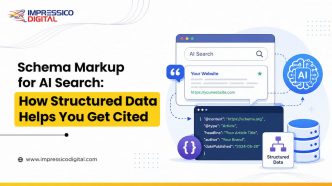
Use Schema Markup to Help Search Engines Understand Your Website
Schema markup provides additional context about your content and helps search engines understand your pages more effectively.
For financial websites, useful schema types include:
- Organization
- Financial Service
- Local Business
- Article
- FAQ
- Breadcrumb
- Person
- Service
While schema doesn’t guarantee higher rankings, it can improve your eligibility for rich search results and AI-powered search experiences.
How to Build a Financial Services SEO Strategy
Building effective financial services SEO strategy starts with understanding your audience and their search intent. At Impressico Digital, we begin by identifying the services customers search for most often and creating optimized service pages supported by educational content. From there, we improve technical performance, implement structured data, strengthen internal linking, and build authoritative backlinks. We also track organic traffic, qualified leads, and conversion rates to continuously refine the strategy for long-term growth.
Common Financial SEO Mistakes
Even experienced financial businesses make mistakes that limit their organic growth.
Avoid these common issues:
- Publishing outdated financial information
- Creating thin or duplicate pages
- Ignoring local SEO
- Missing author information
- Weak internal linking
- Slow website performance
- Keyword stuffing
- Not updating old content
- Missing structured data
Regular SEO audits help identify these problems before they affect rankings and conversions.
When we evaluate financial websites, we frequently find that the biggest challenge isn’t a lack of content—it’s a lack of content structure. Valuable articles often exist, but without strong internal linking, clear topic clusters, and regular updates, they struggle to build topical authority or perform consistently in search results.
Financial SEO Compliance Checklist
Before publishing new content, review this checklist.
| Checklist | ✓ |
| HTTPS enabled | ☐ |
| Author credentials included | ☐ |
| Privacy Policy available | ☐ |
| Editorial Policy published | ☐ |
| Financial disclosures added | ☐ |
| Contact information visible | ☐ |
| Structured data implemented | ☐ |
| Internal links reviewed | ☐ |
| Content fact-checked | ☐ |
| Last updated date displayed | ☐ |
This simple framework improves trust, content quality, and long-term SEO performance.
30-Day Financial Services SEO Roadmap
If you’re just getting started, focus on steady improvements instead of trying to optimize everything at once.
Week 1: Audit your website, research competitors, and identify target keywords.
Week 2: Improve technical SEO, page speed, metadata, and internal linking.
Week 3: Publish educational content, optimize service pages, and create FAQs.
Week 4: Build quality backlinks, monitor performance, and update older content based on new insights.
This phased approach makes SEO more manageable while creating a stronger long-term foundation.
Review performance regularly using Google Search Console and analytics tools to identify which pages attract qualified traffic and where additional optimization is needed.
FAQs
1. What is financial services SEO?
Financial services SEO is the process of improving the online visibility of banks, financial advisors, fintech companies, insurance providers, and other financial businesses through organic search optimization.
2. Why is banking SEO important?
Banking SEO helps financial institutions appear in search results when customers look for banking products, nearby branches, or financial services online.
3. How is fintech SEO different from banking SEO?
Fintech SEO focuses on digital financial products like payment platforms and financial apps, while banking SEO is centered on traditional banking services and local customer acquisition.
4. How long does financial SEO take to show results?
Most businesses begin seeing meaningful improvements within three to six months, although highly competitive keywords may take longer.
5. What is E-E-A-T in financial SEO?
E-E-A-T refers to Experience, Expertise, Authoritativeness, and Trustworthiness. These principles help Google evaluate the quality and credibility of financial content.
6. Which schema markup should financial websites use?
Organization, Financial Service, Article, FAQ, Person, Local Business, and Service schema are among the most useful for financial websites.
7. Can local financial businesses benefit from SEO?
Absolutely. Local SEO helps banks, insurance agencies, accounting firms, and financial advisors attract nearby customers searching for financial services.
8. How does AI Overview impact financial SEO?
AI Overview rewards websites that provide accurate, well-structured, trustworthy, and comprehensive information. Optimizing for user intent and E-E-A-T improves your chances of appearing in AI-generated summaries.
9. Is SEO worth it for financial advisors?
Yes. SEO helps financial advisors reach potential clients who are actively searching for retirement planning, wealth management, tax strategies, and investment advice. Unlike paid ads, SEO can generate consistent organic traffic and qualified leads over the long term.
10. Why is SEO challenging for financial services?
Financial websites compete in a highly regulated industry where trust and accuracy are essential. Since finance falls under Google’s Your Money or Your Life (YMYL) category, websites must demonstrate strong E-E-A-T, publish reliable information, and maintain high technical standards to compete effectively.
11. What KPIs should financial businesses track for SEO?
Important SEO metrics include organic traffic, keyword rankings, qualified leads, conversion rate, click-through rate, local search visibility, engagement time, and organic revenue. These KPIs help measure whether SEO efforts are contributing to business growth rather than just improving rankings.
12. How often should financial websites update their content?
Financial websites should review important pages at least every 6–12 months, or sooner if regulations, financial products, or market conditions change. Regular updates help maintain accuracy, strengthen trust, and keep content relevant for both users and search engines.
Also Read: SEO for B2B Companies: The Complete Guide to Driving Qualified Leads
Final Thoughts
For financial services SEO, ranking is not enough; it is all about gaining trust at the point where people start their customer journey — the internet. With the combination of technical SEO, valuable content, and E-E-A-T signals, you can capture relevant leads and achieve sustainable growth.
At Impressico Digital, we believe the most effective SEO strategy is one that puts people first. When you combine accurate information with smart optimization and a commitment to helping your audience, you create a digital presence that continues to deliver value long after the first click.
Want to know more about us? Follow us on social media!