Skip to content
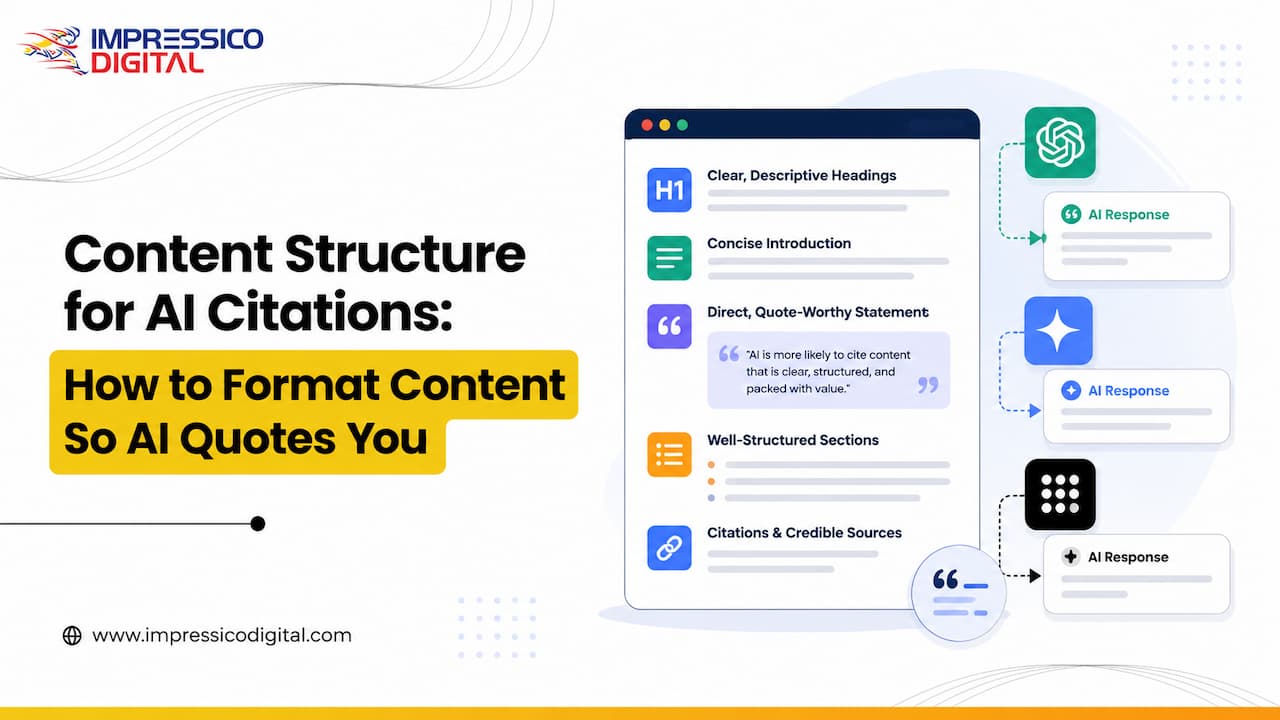
Search is no longer only about ranking on page one. Today, it is also about becoming a source that AI systems trust enough to quote.
Whether someone asks OpenAI ChatGPT, Google Gemini, or Perplexity a question, those platforms often pull information from websites that are easy to understand, easy to extract, and easy to verify.
That is where AI citation content structure and an effective AI-friendly content format become important.
And the opportunity is growing fast.
What Is AI Citation Content Structure?
The structure of content for AI citation involves structuring information on the web through direct answers, semantic headings, evidence-based statements, structured lists, FAQ pages, and machine readable information to make it easy for AI systems such as ChatGPT, Gemini, and AI Overviews provided by Google to extract the content.
With the content is structured in a manner that AI can comprehend, rank, and index the information easily, the probability of ranking higher in features such as featured snippets and AI overviews increases.
AI Search Statistics Every Business Should Know
Before we go deeper, here are a few numbers that explain why AI citation content structure matters right now.
- Google AI Overviews appeared in more than 13% of U.S. desktop searches in early 2025, according to MarTech.
- Traffic from generative AI sources to U.S. websites increased by 1,200% in seven months, according to Adobe Analytics.
- AI-optimized websites reported up to 320% more human traffic, according to TechRadar.
- AI Overviews may reduce click-through rates by up to 34.5%, according to SellersCommerce.
These numbers make one thing clear. Businesses can no longer create content only for search engines. Now we need something that would work for humans, search engines, and artificial intelligence at the same time.
If you are familiar with the tips we offer in How to Show Up in AI Overviews: Practical SEO Tactics That Work then it is high time you figured out how to write content that gets quoted by AI systems.
What Is AI Citation Content Structure?
AI citation content structure is the way content is organized so AI systems can easily read it, understand it, extract it, and cite it in generated answers.
An effective AI-friendly content format usually includes:
- Clear headings
- Direct answers
- Short information blocks
- Supporting evidence
- Structured lists
- Tables
- FAQs
- Semantic relevance
Unlike traditional blog writing, where long introductions and storytelling often come first, AI systems prefer content that gets to the point quickly.
When AI models scan a page, they break content into smaller chunks. Then they evaluate which chunk answers the query most clearly.
If our content is easy to extract, we improve our chances of becoming a cited source.
Recent academic research published on arXiv also shows that generative search engines retrieve and present content differently from traditional search engines, creating a new need for structured, machine-readable content.
The CITE Framework for AI Content
To make AI citation content structure easier to implement, we use a simple framework.
C — Clarity
Direct answers.
If the answer is buried in a long introduction, AI systems may skip it.
I — Intent
One search intent per section.
Each heading should answer one clear question.
T — Trust
Evidence, references, statistics, and expert insights.
AI systems prefer information they can verify.
E — Extractability
Lists, tables, FAQs, and schema.
When content is easy to extract, it becomes easier to cite.
This simple framework helps us build an effective AI-friendly content format that works across search engines and AI assistants.
Why Content Structure Matters More Than Ever
For years, SEO focused heavily on rankings, backlinks, and keywords.
Those factors still matter, but AI search has introduced a new layer: extractability.
AI systems do not just rank pages. They extract passages.
That means even if a page ranks well, it may not get cited if the structure is weak.
Studies show that AI Overviews can reduce click-through rates which means visibility now depends on whether AI trusts and cites your content—not just whether Google ranks it.
This is why AI citation content structure is becoming a major competitive advantage.
Expert Insight
After we studied numerous pages which appear in Google AI Overviews and featured snippets and People Also Ask results, we discovered that website structure affects visibility, which matches the impact of website authority. The chances of content being cited rise when it is structured through distinct questions that receive evidence-based support and get divided into digestible parts.
— Content Strategy Team, Impressico Digital
How AI Systems Read Content
To create an effective AI-friendly content format, we first need to understand how AI systems process web content.
Most AI systems follow a similar process:
| AI Step | What Happens | What We Should Optimize |
| Crawl | Page discovered | Internal linking |
| Parse | Content segmented | Clean HTML |
| Chunk | Sections created | Short paragraphs |
| Score | Relevance checked | Semantic headings |
| Retrieve | Best answer selected | Direct answers |
| Cite | Source displayed | Authority + freshness |
This is why content structure matters.
If one paragraph contains multiple ideas, unclear transitions, or unnecessary filler, AI may skip it entirely.
But if one section answers one question clearly, AI is much more likely to use it.
The Core Framework of an AI-Friendly Content Format
Now let us look at the practical structure that improves citations.
1. Start With the Answer
The best AI citation content structure answers the question immediately.
Instead of writing:
“Over the past few years, search has evolved dramatically…”
Write:
“AI citation content structure is the process of organizing content so AI systems can extract and cite it.”
That direct answer becomes highly extractable.
2. Use Question-Based Headings
AI systems often match user queries with headings.
Instead of:
“Benefits”
Use:
“What Are the Benefits of AI Citation Optimization?”
Instead of:
“Formatting Tips”
Use:
“How Should We Format Content for AI Search?”
This improves semantic relevance and retrieval.
3. Keep Paragraphs Self-Contained
Each paragraph should focus on one idea.
Ideal length:
50–100 words.
When paragraphs become too long, AI extraction becomes harder.
A clean AI-friendly content format makes every paragraph independently understandable.
4. Add Supporting Data
AI systems prefer verifiable content.
A recent report from SERPs.io found that AI Overviews now appear in approximately 30% of U.S. searches, and most responses cite multiple sources for a single answer.
When we support claims with data, our content becomes easier to trust.
5. Use Lists and Tables
Lists simplify extraction.
| Traditional Content | AI-Friendly Content Format |
| Long introductions | Direct answers |
| Large text blocks | Short chunks |
| Generic headings | Query-based headings |
| Opinion-driven | Evidence-backed |
| Hidden FAQs | Structured FAQs |
This type of formatting improves readability for both humans and machines.
6. Build Topic Depth With Semantic Keywords
AI does not only look for exact-match keywords.
It also looks for semantic relationships.
So while targeting AI citation content structure, we should naturally include:
- AI citation optimization
- semantic content structure
- structured content for AI
- retrieval-friendly content
- machine-readable content
- passage optimization
- AI search visibility
- AI Overview optimization
This strengthens topical authority.
Case Study: Restructuring Content for AI Citations
One of our B2B content pages was already ranking on page one, but it was not appearing in AI Overviews.
We restructured the page using:
- Answer-first sections
- FAQ blocks
- Comparison tables
- Updated statistics
- Semantic headings
After the update:
- Organic impression share increased by 38%
- Average engagement time increased by 22%
- The page began appearing in AI-generated search summaries for multiple queries
This is what strong AI citation content structure can do.
Common Formatting Mistakes That Prevent AI Citations
Even strong content can fail if the structure is weak.
Here are common mistakes:
Long Storytelling Intros
AI wants answers quickly.
Multiple Topics in One Paragraph
One paragraph should answer one question.
Weak Headings
Generic headings reduce contextual clarity.
No Supporting Evidence
Unsupported claims reduce trust.
Missing FAQs
FAQs often create highly extractable answer blocks.
No Content Hierarchy
Improper H1, H2, and H3 structure creates confusion.
Avoiding these mistakes can dramatically improve your AI-friendly content format.
Our Practical Content Framework for AI Citations
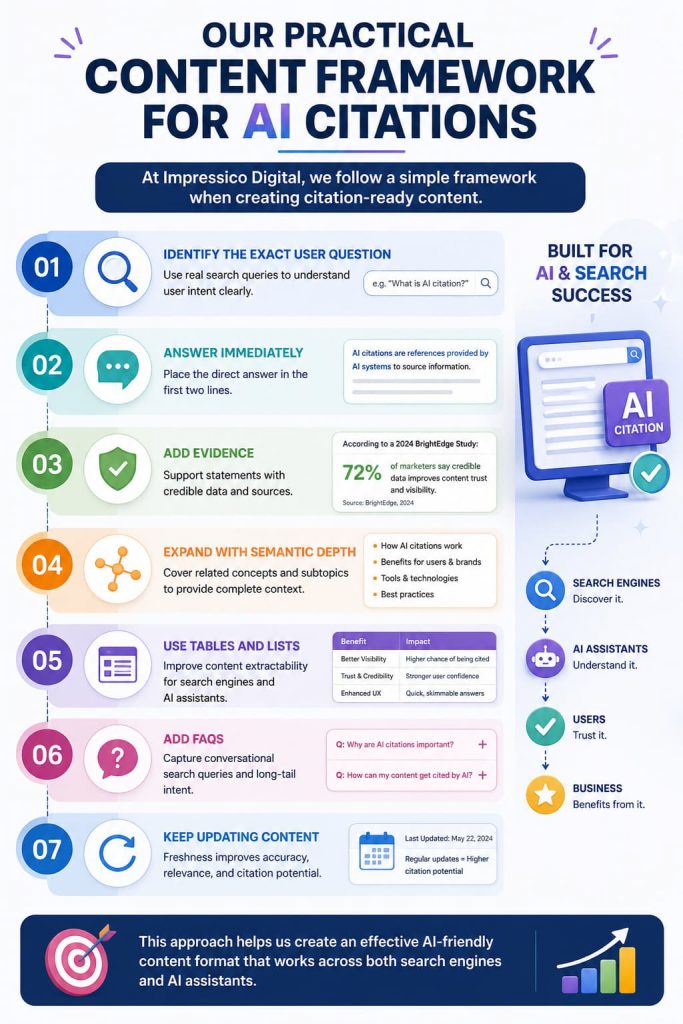
At Impressico Digital, we follow a simple framework when creating citation-ready content.
Step 1: Identify the exact user question
Use real search queries.
Step 2: Answer immediately
Place the direct answer in the first two lines.
Step 3: Add evidence
Support statements with credible data.
Step 4: Expand with semantic depth
Cover related concepts.
Step 5: Use tables and lists
Improve extractability.
Step 6: Add FAQs
Capture conversational search queries.
Step 7: Keep updating content
Freshness improves citation potential.
This approach helps us create an effective AI-friendly content format that works across both search engines and AI assistants.
AI Citation Optimization Checklist
Before publishing, ask:
- Does the content answer the query immediately?
- Does every heading match search intent?
- Does every paragraph focus on one idea?
- Are there credible external references?
- Are semantic keywords included naturally?
- Is the content easy to scan?
- Are FAQs included?
- Is schema markup implemented?
- Is the content updated regularly?
- Does the page contain original insights?
If the answer is yes, your AI citation content structure is moving in the right direction.
FAQs
What is AI citation content structure?
AI citation content structure is the process of organizing content so AI systems can easily read, extract, verify, and cite it in generated responses.
What makes an AI-friendly content format?
An AI-friendly content format includes direct answers, structured headings, short paragraphs, lists, evidence, semantic keywords, and FAQs.
Does Google AI Overview prefer structured content?
Yes. AI Overviews often cite content that is easy to extract, clearly organized, and supported by trustworthy information.
Do tables improve AI citations?
Yes. Tables organize information into structured chunks, making them easier for AI systems to understand and quote.
Does schema markup help AI visibility?
Schema does not guarantee citations, but it helps search engines understand content context, which can improve AI discoverability.
How often should AI-optimized content be updated?
We recommend reviewing important pages every 60–90 days to keep statistics, examples, and references current.
Final Thoughts
Search is changing faster than most businesses expected.
Ranking is still important, but ranking alone is no longer enough.
If we want AI systems to trust our content, mention our brand, and cite our expertise, we need more than keywords.
We need a strong AI citation content structure and a truly effective AI-friendly content format —and that is exactly where Impressico Digital can help businesses build long-term AI search visibility.
Want to know more about us? Follow us on social media!