Skip to content
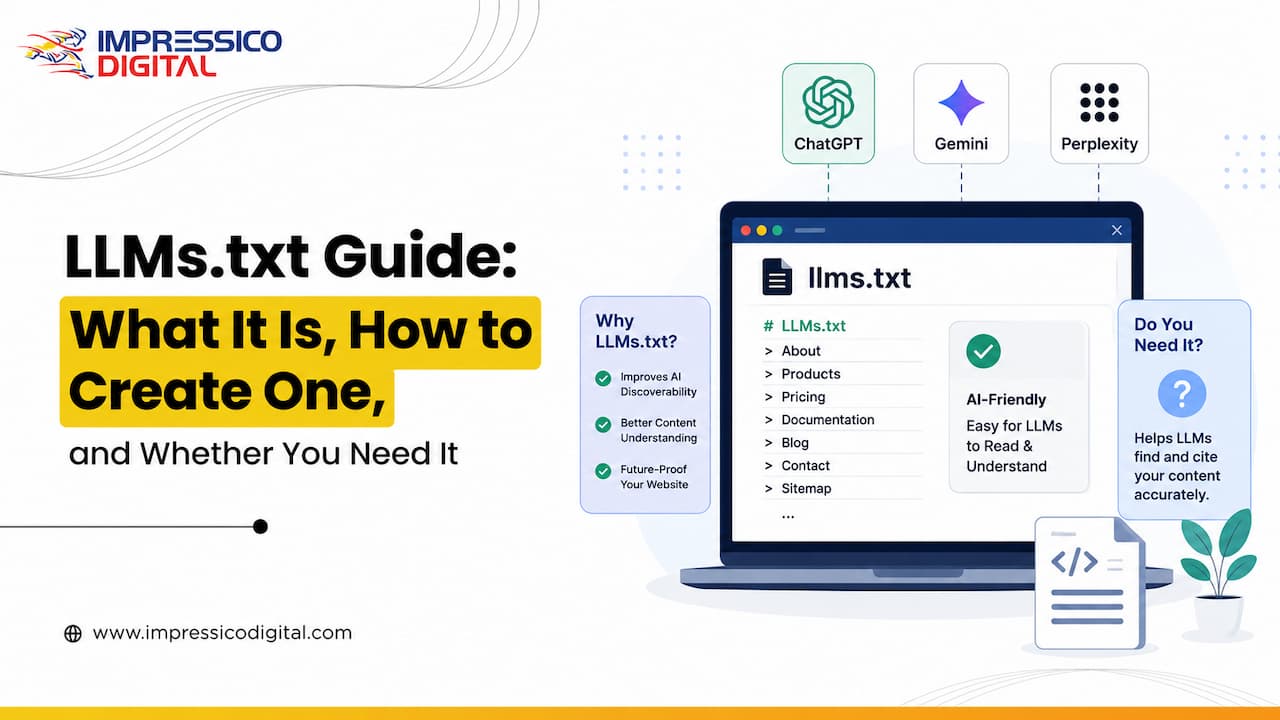
The dynamics of search are evolving much quicker than anticipated. A couple of years back, SEO optimization would suffice to rank higher among search engine results. This would give the website a good chance of attracting the attention, clicks, and authority that were necessary. But today, everything seems to have changed. Instead of searching using keywords in search engines, people are posing questions within artificial intelligence platforms like OpenAI ChatGPT, Google Gemini, and Perplexity AI Perplexity.
This trend is not an abstract one. It is happening and supported by industry data showing AI-based discoveries evolving into an actual search layer with millions of active users per day. Also, studies indicate that summary answers generated using AI can lower the traffic on publishers’ sites by significant figures.
As marketers, the key question we should be asking ourselves at this point is, How can we enable AI systems to understand our webpages better?
That is exactly where llms.txt enters the conversation.
In this guide, we will explain what an llms.txt file is, how to create one, whether an AI crawler file actually matters today, and how businesses can think about llms.txt as part of a broader AI visibility strategy.
If you have already explored topics like How LLMs Are Transforming SEO and Digital Marketing, this guide will help you move one step deeper into technical implementation.
What Is llms.txt?
An llms.txt file is a text-based file placed in the root directory of your website. It is designed to help large language models understand your most important pages in a cleaner, simpler format.
Think of an llms.txt file as an early version of an AI crawler file. Instead of forcing AI systems to process complex navigation menus, JavaScript elements, banners, sidebars, and other HTML clutter, an llms.txt file gives AI crawlers a direct roadmap to your most valuable content.
Most implementations use Markdown formatting, which makes the file lightweight, easy to read, and machine-friendly.
A typical llms.txt file lives here:

The idea is simple. When an AI crawler visits your domain, it can look for your llms.txt file, read your curated content structure, and better understand what your website is about.
Why Are Businesses Talking About llms.txt Now?
The rise of AI search is one reason. The second reason is crawler behavior.
Recent data from cloudflare shows that AI crawlers now account for about 4.2% of global HTML requests, while Googlebot alone adds another 4.5%, which means machine-based traffic is becoming impossible to ignore. Cloudflare also found that training-related AI crawling now represents nearly 80% of AI bot activity.
That tells us something important.
AI systems are already consuming web content at scale.
The question is no longer if AI systems are reading websites.
The real question is whether they are understanding your content correctly.
That is where an AI crawler file like llms.txt becomes interesting.
How is llms.txt Different from robots.txt?
Many businesses hear about llms.txt and immediately ask whether it replaces robots.txt.
The answer is no.
These files serve very different purposes.
robots.txt
A robots.txt file tells crawlers what they can or cannot access.
Example:
- Block folders
- Restrict admin areas
- Control crawl permissions
sitemap.xml
A sitemap tells search engines which pages exist.
Example:
- URLs
- Last updated dates
- Priority hints
llms.txt
An llms.txt file tells AI systems which pages matter most and why.
Example:
- Homepage summary
- Service pages
- Research content
- FAQs
- Case studies
So while robots.txt controls access, an AI crawler file like llms.txt focuses on clarity.
Why Traditional HTML Is Hard for AI Systems
Modern websites are built for humans.
That sounds obvious, but it creates a challenge for machines.
A typical webpage contains:
- Navigation menus
- Pop-ups
- Tracking scripts
- Cookie banners
- Promotional banners
- Footer links
- Dynamic widgets
AI systems often need to process all of that before finding the real content.
An llms.txt file removes that friction.
Instead of making AI models guess what matters, you tell them directly.
That creates a cleaner retrieval layer.
Does llms.txt Actually Improve AI Visibility?
This is the most important question.
The honest answer is:
There is no official confirmation yet from major AI platforms that llms.txt directly improves citations or rankings.
That matters.
Research from industry studies suggests adoption is still early.
One analysis by SE Ranking of 300,000 domains found limited evidence that llms.txt alone changes AI visibility.
Community audits also tell a similar story.
One CDN log analysis across 1,000 websites found that major bots like GPTBot, ClaudeBot, and PerplexityBot rarely requested the llms.txt file, while Googlebot generated most of the observed traffic.
From Reddit’s SEO community:
“GPTBot, ClaudeBot, or PerplexityBot didn’t visit.”
So does that mean llms.txt is useless?
Not at all.
It means llms.txt should not be viewed as a magic ranking signal.
Instead, it should be viewed as a low-risk clarity layer.
How to Create an llms.txt File
Creating an llms.txt file is surprisingly simple.
Here is the process we recommend.
Step 1: Identify Your Most Important Pages
Choose pages that represent your expertise.
Examples:
- Homepage
- About page
- Service pages
- Industry research
- Resource hubs
- FAQs
- Case studies
Do not include every page.
An AI crawler file works best when it is curated.
Step 2: Write Clear Summaries
Each URL should have a short description.
For example:
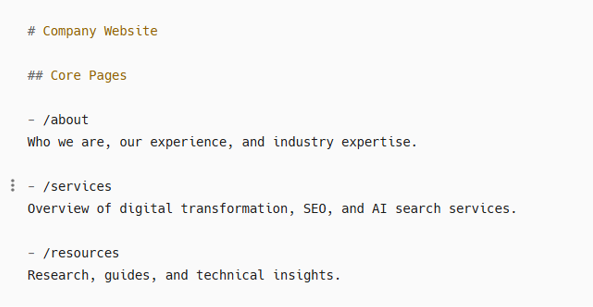
This gives AI systems context, not just links.
Step 3: Save the File
Save the file as:
Not:
- llm.txt
- llmfile.txt
- AI.txt
The exact filename matters.
Step 4: Upload to Root Directory
Place it here:
Step 5: Test Accessibility
Open it in your browser.
- If it loads publicly, your txt file is live.
Common Mistakes with llms.txt
We see businesses make the same mistakes again and again.
- Including every URL
This defeats the purpose.
Your AI crawler file should prioritize quality, not quantity.
- Writing vague descriptions
Avoid generic summaries.
Instead of:
“Services page”
Write:
“Enterprise SEO, GEO, and AI search optimization solutions.”
- Never updating the file
If your content changes, your llms.txt file should change too.
Who Should Use an llms.txt File?
Not every website needs one immediately.
But certain businesses can benefit from early adoption.
- SaaS companies
Complex products need structured explanations.
- Enterprise brands
Multiple service lines benefit from clearer AI retrieval.
- Publishers
Editorial websites want accurate citations.
- Agencies
Thought leadership content needs better machine understanding.
- Knowledge-driven brands
Research-heavy content benefits from clean discovery paths.
What llms.txt Cannot Do
It is equally important to understand what llms.txt does not do.
An AI crawler file cannot:
- Guarantee citations
- Guarantee ChatGPT mentions
- Replace structured data
- Replace schema markup
- Replace content quality
- Replace authority signals
Think of llms.txt as one signal inside a larger AI optimization system.
What Actually Improves AI Visibility?
From what we are seeing across AI search optimization, visibility comes from combining multiple layers:
- Strong entity signals
Clear brand identity.
- Structured data
Schema markup.
- Authoritative research
Original statistics and insights.
- Internal linking
Connected topic clusters.
- Freshness
Updated content.
- Machine-readable summaries
This is where llms.txt fits.
As one SaaS marketer recently put it in community testing:
“llms.txt itself rarely moves rankings.” (Reddit)
We agree.
The real value comes when llms.txt, schema, content architecture, and internal linking work together.
Should Your Business Implement llms.txt?
Our answer is simple.
If your website depends on authority, citations, and future AI visibility, implementing an llms.txt file is a smart low-effort experiment.
It may not move rankings tomorrow.
It may not generate traffic overnight.
But it helps create a cleaner discovery layer for machines.
And as AI search evolves, that kind of technical readiness can become a competitive advantage.
FAQs
What is an llms.txt file?
An llms.txt file is a machine-readable file that helps AI systems understand your most important content.
Where should an llms.txt file be placed?
At your domain root.
Example:
yourdomain.com/llms.txt
Is llms.txt the same as robots.txt?
No. robots.txt controls access. llms.txt provides context.
Does ChatGPT use llms.txt?
There is currently no official public confirmation from major AI providers.
Does an AI crawler file improve citations?
Possibly as part of broader optimization, but not as a standalone ranking factor.
Should every business create an llms.txt file?
Not necessarily, but knowledge-driven brands should seriously consider it.
Final Thoughts
Search is no longer just about ranking pages. It is increasingly about becoming a trusted source that AI systems can confidently reference.
An llms.txt strategy will not replace great content. It will not replace structured data. And it will not replace authority.
But it can help reduce ambiguity.
And in AI search, clarity matters.
As we continue helping brands adapt to AI-first discovery, we believe technical foundations like the llms.txt file, schema, and strong content architecture will play a bigger role in how businesses earn visibility across search, AI assistants, and emerging answer engines.
That is exactly where Impressico Digital helps businesses stay ahead.
Want to know more about us? Follow us on social media!