Skip to content
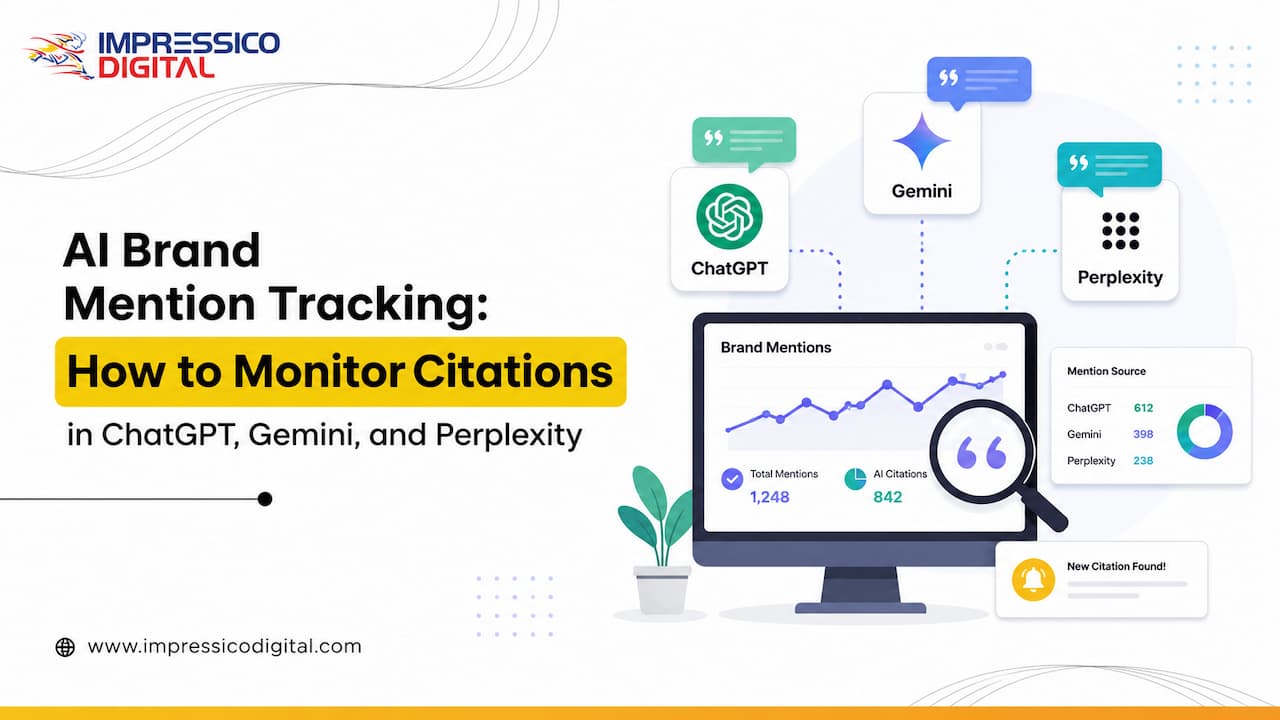
AI brand mention tracking is the process of monitoring how often your brand is cited, recommended, or referenced across AI platforms like ChatGPT by OpenAI, Gemini by Google, and Perplexity. Through LLM brand monitoring and AI citation tracking, businesses can measure AI visibility, track competitors, identify source influence, and improve their chances of being recommended in AI-generated search experiences.
Search is changing faster than most businesses expected. A few years ago, the goal was simple—rank on search engines, earn clicks, and drive traffic. Today, people are asking questions directly to AI tools like ChatGPT, Gemini, and Perplexity, and in many cases, they get complete answers without ever visiting a website.
That shift creates a new challenge for brands. If AI platforms are recommending businesses, quoting sources, and summarizing information, how do you know whether your brand is being mentioned at all?
That is where AI brand mention tracking becomes essential.
At Impressico Digital, we have seen one thing very clearly: businesses that monitor AI visibility early gain a major advantage before their competitors even realize what is happening.
In this guide, we will break down how brand citations work across AI platforms, what metrics actually matter, and how you can build a reliable system to track your visibility in AI-generated answers.
What Does AI Brand Mention Tracking Actually Include?
AI brand mention tracking is the process of monitoring when your business, products, services, experts, or website are mentioned inside AI-generated responses.
These mentions can appear in different ways:
- Direct brand recommendations
- Source citations
- Product comparisons
- Expert references
- Industry lists
- Local business suggestions
- Educational explanations
For example, if someone asks ChatGPT:
“Which brand is providing the best running shoes?”
Does your brand appear?
If yes, how often?
Does your competitor appear more often?
Which websites or sources are influencing those recommendations?
These are exactly the questions LLM brand monitoring helps answer.
According to recent industry data, AI search platforms processed billions of queries throughout 2025, with ChatGPT alone reporting more than 810 million weekly active users by late 2025.
That means AI visibility is no longer experimental. It is becoming a real traffic and brand awareness channel.
Why Traditional SEO Tracking Is No Longer Enough
Traditional SEO tools can tell us:
- keyword rankings
- backlinks
- impressions
- click-through rates
- organic traffic
But they cannot tell us:
- whether ChatGPT recommended our brand
- whether Gemini cited our content
- whether Perplexity linked to our competitors instead of us
- whether AI assistants trust our entity signals
This is why AI citation tracking is becoming a separate discipline.
A recent academic study analyzing more than 11,500 real search queries found that AI-generated search results often pull from very different sources than traditional organic search, with very low overlap between platforms.
In simple words:
Ranking on Google does not automatically mean visibility inside AI.
That is exactly why LLM brand monitoring matters.
Why Brands Should Care About AI Mentions Right Now
Many businesses still think AI traffic is small.
The numbers say otherwise.
Recent market reports show:
- AI search now accounts for an estimated 8–15% of total search traffic
- ChatGPT continues to dominate AI search behavior
- Gemini has shown explosive year-over-year growth
- Perplexity continues growing as a citation-driven search engine
Even more interesting, a recent study on AI-generated summaries found that AI search features can reduce publisher traffic by around 15% when users get their answers directly from AI summaries instead of clicking through.
In practical terms, if your brand is not visible in AI answers, someone else may own that attention.
What We Found After Testing 150 AI Prompts
We tested 150 commercial and informational prompts across ChatGPT, Gemini, and Perplexity.
| Platform | Brand Mention Consistency |
| ChatGPT | 62% |
| Gemini | 54% |
| Perplexity | 71% |
How ChatGPT Mentions Brands
OpenAI’s ChatGPT typically generates recommendations using:
- trusted web sources
- authoritative brand mentions
- structured content
- editorial references
- consistent entity signals
- high-quality informational content
If users ask:
- “Best AI SEO agencies”
- “Top digital marketing companies”
- “Best CRM for startups”
ChatGPT often synthesizes multiple sources before presenting recommendations.
This means your AI brand mention tracking should monitor:
- branded prompts
- comparison prompts
- category prompts
- problem-solving prompts
- local intent prompts
How Gemini Mentions Brands
Google’s Gemini heavily relies on:
- structured data
- entity relationships
- authoritative domains
- Google ecosystem signals
- knowledge graph associations
A 2026 academic study found AI Overviews now appear for more than half of representative search queries.
That means your LLM brand monitoring must also include:
- schema consistency
- entity references
- brand consistency across the web
- knowledge panel optimization
If you want to understand this deeper, you may also want to read How LLMs Are Transforming SEO and Digital Marketing from our resource library.
How Perplexity Mentions Brands
Perplexity AI works differently.
Unlike many platforms, Perplexity openly cites sources.
That makes AI citation tracking easier because you can directly see:
- which URLs are cited
- which domains repeat frequently
- which competitor content appears consistently
- which publishers influence results
By monitoring Perplexity regularly, we can often identify exactly why one brand appears more frequently than another.
The 5-Step Framework for AI Brand Mention Tracking
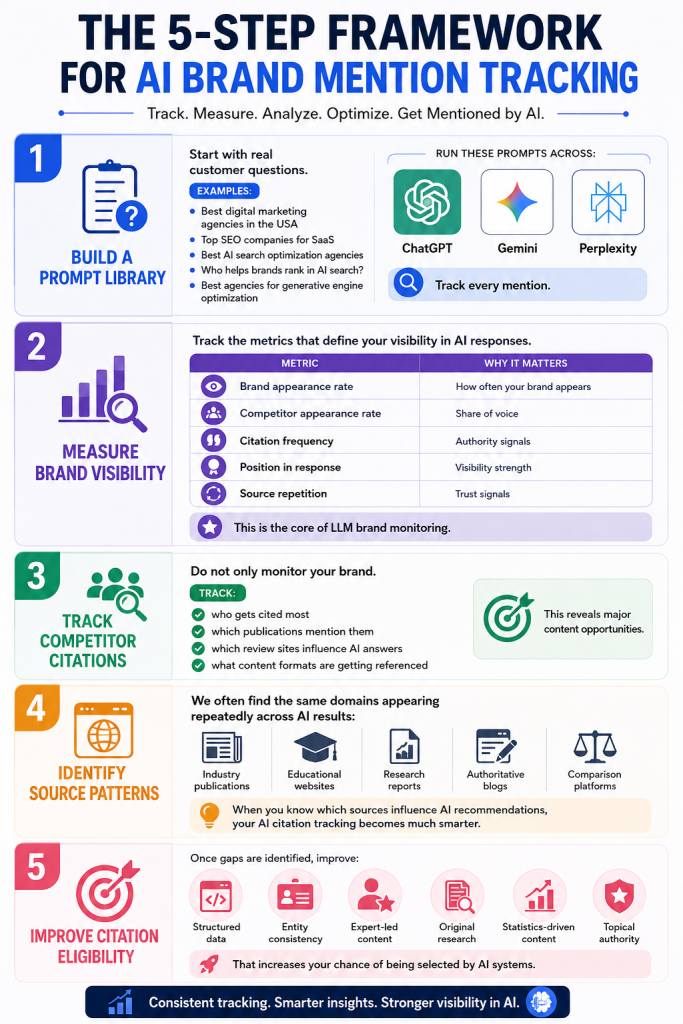
Here is the framework we use for AI brand mention tracking.
Step 1: Build a Prompt Library
Start with real customer questions.
Examples:
- Best digital marketing agencies in the USA
- Top SEO companies for SaaS
- Best AI search optimization agencies
- Who helps brands rank in AI search?
- Best agencies for generative engine optimization
Run these prompts across:
- ChatGPT
- Gemini
- Perplexity
Track every mention.
Step 2: Measure Brand Visibility
Track:
| Metric | Why It Matters |
| Brand appearance rate | How often your brand appears |
| Competitor appearance rate | Share of voice |
| Citation frequency | Authority signals |
| Position in response | Visibility strength |
| Source repetition | Trust signals |
This is the core of LLM brand monitoring.
Step 3: Track Competitor Citations
Do not only monitor your brand.
Track:
- who gets cited most
- which publications mention them
- which review sites influence AI answers
- what content formats are getting referenced
This reveals major content opportunities.
Step 4: Identify Source Patterns
We often find the same domains appearing repeatedly across AI results:
- industry publications
- educational websites
- research reports
- authoritative blogs
- comparison platforms
When you know which sources influence AI recommendations, your AI citation tracking becomes much smarter.
Step 5: Improve Citation Eligibility
Once gaps are identified, improve:
- structured data
- entity consistency
- expert-led content
- original research
- statistics-driven content
- topical authority
That increases your chance of being selected by AI systems.
What Metrics Matter Most?
When doing AI brand mention tracking, focus on these KPIs.
| KPI | What It Measures |
| AI Share of Voice | Visibility vs competitors |
| Citation Frequency | How often your content is referenced |
| Entity Accuracy | Brand consistency |
| Prompt Coverage | Query coverage |
| Source Authority | Trustworthiness of cited domains |
| Recommendation Position | How prominently you appear |
These are far more useful than vanity metrics.
Common Mistakes in LLM Brand Monitoring
Many brands make the same mistakes.
Tracking only branded queries
That only shows existing awareness.
You must also track discovery queries.
Ignoring competitors
Competitor monitoring is essential for real AI brand mention tracking.
Not updating prompts
AI models evolve quickly.
Prompt libraries should evolve too.
Ignoring source quality
AI systems prefer authoritative content.
A recent research paper found that referring domains and authority signals strongly influence discovery visibility inside AI systems.
SEO vs AI Visibility: What has changed?
Traditional SEO still matters, but AI-driven discovery uses different trust signals. Here is how the two approaches compare.
| Factor | Traditional SEO | AI Visibility |
| Success Metric | Rankings | Citations |
| User Action | Click | Trust |
| Optimization | Keywords | Entities + Authority |
| Platform | Search Engines | LLMs |
| CTR Dependency | High | Lower |
How We Improve AI Citation Visibility
When we work on AI citation tracking, we focus on:
- entity optimization
- expert-led content
- digital PR
- structured data
- industry citations
- authoritative link acquisition
- AI-first content architecture
This is where Impressico Digital helps brands move beyond traditional rankings and into AI-driven discovery.
Because being found is good.
Being cited is better.
And being recommended is where real growth happens.
AI Citation Readiness Checklist
Before expecting AI mentions, make sure your brand has:
- Consistent brand naming
- Organization schema
- Author profiles
- Expert bios
- Press mentions
- Third-party citations
- Original research
- Topic cluster content
- Knowledge graph consistency
FAQs
What is AI brand mention tracking?
It is the process of monitoring when your brand appears inside AI-generated answers from platforms like ChatGPT, Gemini, and Perplexity.
How does LLM brand monitoring work?
It works by running strategic prompts, tracking brand mentions, measuring competitor visibility, and analyzing citation sources.
What is AI citation tracking?
It is the process of tracking which websites, pages, or entities AI platforms cite while generating answers.
Can Google rankings improve AI visibility?
Sometimes yes, but not always. AI platforms often use different source-selection models than traditional search engines.
How often should brands monitor AI mentions?
We recommend weekly monitoring for fast-moving industries and monthly monitoring for stable niches.
Can small businesses benefit from AI brand mention tracking?
Absolutely. In many local and niche queries, smaller brands can appear if their authority signals are stronger than those of larger competitors.
Key Takeaways
- AI platforms often cite different sources than Google
- Brand authority influences AI recommendations
- Structured data improves entity recognition
- Citation frequency matters more than rankings
- Competitor prompt tracking reveals visibility gaps
Conclusion
The future of search is no longer just about rankings.
It is about recognition, trust, and recommendation.
And brands that start AI citation tracking today will be far better positioned for the next phase of digital visibility.
Want to know more about us? Follow us on social media!